
Most people think of melatonin as a sleep aid. Take a tablet, fall asleep faster, wake up rested. But the relationship between melatonin and testosterone is more layered than the supplement aisle suggests, and for men thinking about hormone health, it is worth understanding.
Melatonin is produced by the pineal gland in response to darkness. It signals to the body that it is time to sleep, plays a role in regulating circadian rhythms, and also functions as an antioxidant at the cellular level. Testosterone, produced mainly in the testes, operates on its own daily rhythm – levels are typically highest in the morning and decline through the day. These two systems are more connected than most people realize.
What Melatonin Does in the Body
Melatonin is sometimes called the “darkness hormone.” It is synthesized from serotonin and released by the pineal gland when light levels drop at night. Its primary role is to help the body shift into sleep mode – lowering core body temperature, reducing alertness, and preparing the biological systems associated with rest and recovery.
Beyond sleep regulation, melatonin has antioxidant properties. It helps neutralize free radicals and may offer some degree of cellular protection, including in reproductive tissues. This is one of the reasons researchers have looked at whether melatonin has any direct interaction with testosterone production in the testes.
The Relationship Between Melatonin and Testosterone
These interactions involve several pathways, and not all of them point in the same direction.
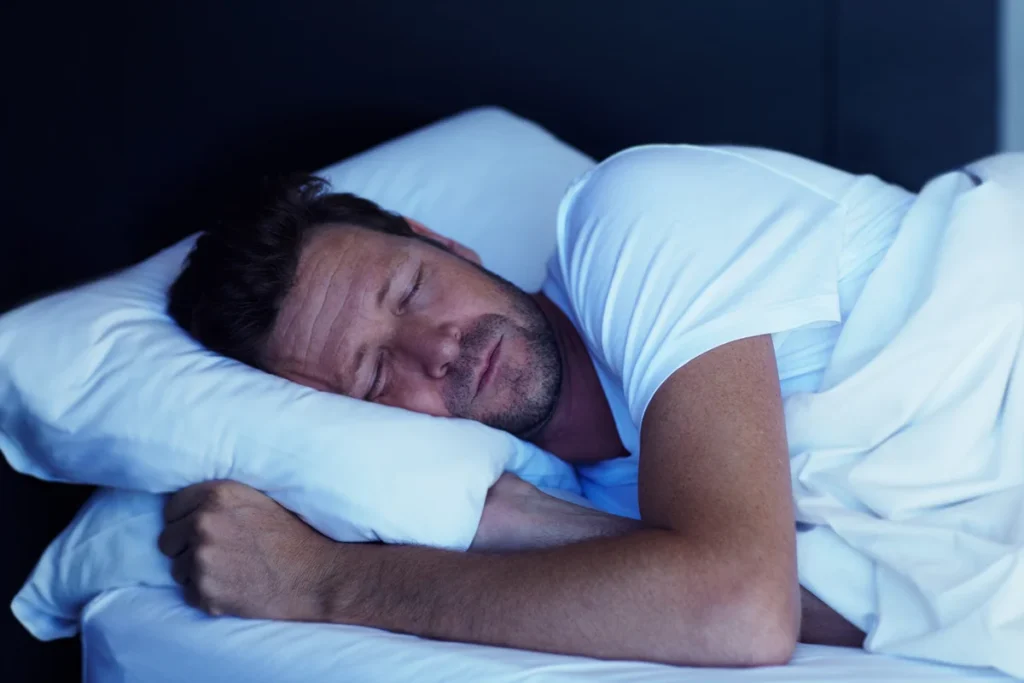
Sleep quality is the clearest link. Testosterone production is closely tied to sleep. The bulk of daily testosterone release is associated with sleep cycles – particularly deep, slow-wave sleep and REM sleep. When melatonin does its job properly, supporting good sleep onset and maintaining sleep architecture, the conditions for healthy testosterone production are in place. Poor sleep, on the other hand, is consistently associated with lower testosterone levels. Research indicates that even a week of sleep restriction can meaningfully reduce testosterone in otherwise healthy men.
Melatonin’s antioxidant role in testicular cells. Some research suggests that melatonin may have a protective effect on the Leydig cells in the testes – the cells responsible for producing testosterone. The antioxidant properties of melatonin may help protect these cells from oxidative stress, which can impair their function over time. This area of research is ongoing, and most of it comes from animal studies or in vitro work, so translating these findings to clear clinical guidance requires caution.
The hormonal signaling pathway. Testosterone production is regulated by the hypothalamus-pituitary-gonadal (HPG) axis. The hypothalamus releases gonadotropin-releasing hormone (GnRH), which signals the pituitary to release LH and FSH, which in turn signal the testes to produce testosterone. Melatonin receptors are present in several parts of this axis, including the hypothalamus and pituitary. In seasonal animals, melatonin plays a major role in regulating reproductive cycles based on day length. In humans, the effect is far less pronounced but may still be a background influence on hormonal signaling.
Do Melatonin Supplements Affect Testosterone Levels?
This is where the picture gets more complex. When it comes to supplementation, the picture is not straightforward, and the evidence does not point clearly in one direction.
Some studies suggest that high-dose melatonin supplementation may temporarily suppress LH and FSH, which could theoretically affect testosterone production – particularly at doses well above what would normally be needed for sleep support. Other research has not found meaningful effects on testosterone levels with supplementation at typical doses.
The dose matters significantly. Most over-the-counter melatonin products come in doses far higher than the physiological amount the body produces naturally (which is in the microgram range). Taking 5mg or 10mg is a very different signal to the body than the small amounts the pineal gland releases.
For most men using melatonin occasionally at reasonable doses to support sleep quality, the practical effect on testosterone levels is likely minimal. But for men who are using melatonin regularly at high doses and are also experiencing symptoms of low testosterone, it may be worth discussing with a clinician.
Why Sleep Matters So Much for Testosterone
The most reliable, well-established link runs through sleep quality. This is not a subtle relationship – it is one of the more robust findings in hormone research.
Testosterone follows a circadian pattern. Levels peak in the early morning hours, timed to sleep cycles, and decline throughout the day. Men who sleep fewer than five or six hours consistently show lower testosterone levels than men who sleep seven to nine hours. Shift workers, people with sleep apnea, and those with chronic insomnia often show hormonal disruptions that include testosterone suppression.
Melatonin supports the conditions that make good sleep possible. When natural melatonin production is disrupted – by exposure to blue light at night, irregular schedules, high stress, or aging (melatonin production does decline with age) – sleep quality typically suffers, and testosterone levels may follow.
Supporting healthy melatonin rhythms through sleep hygiene – consistent bedtimes, limiting screen exposure in the evenings, keeping the bedroom dark and cool – is one of the most underrated tools for men thinking about hormone health.
When to Consider a Hormone Evaluation
Symptoms that prompt men to seek answers about hormone health are often the same symptoms associated with suboptimal hormone levels in general: low energy, reduced sex drive, difficulty building or maintaining muscle, mood changes, and poor sleep quality.
The challenge is that these symptoms have many possible causes. Poor sleep alone can produce all of them. Low testosterone can produce all of them. Thyroid issues, nutrient deficiencies, chronic stress, and other factors can too. Without actual data from comprehensive blood work, it is difficult to know which factor – or which combination – is actually driving what someone feels.
A hormone panel that includes total and free testosterone, LH, FSH, SHBG, estradiol, and thyroid markers gives a meaningful baseline picture. From there, a clinician can assess whether levels are within a healthy range or whether something like hormone optimization – including testosterone replacement therapy – may be appropriate to consider.
TRT is not a blanket solution for fatigue or sleep problems, but for men with clinically confirmed low testosterone who are also dealing with symptoms that affect quality of life, it may be associated with meaningful improvements in energy, mood, body composition, and overall function.
FAQ
At typical supplemental doses used for sleep support, melatonin is unlikely to meaningfully lower testosterone for most men. Higher doses may theoretically influence the hormonal signaling pathway, but the evidence is not conclusive. If low testosterone is a concern, a blood test is a more reliable starting point than adjusting supplement use.
Melatonin supports testosterone indirectly by promoting sleep quality, which is essential for testosterone synthesis. It may also have a direct protective role in testicular cells through its antioxidant properties. The direct hormonal relationship in humans is complex and still being studied.
Evidence suggests that optimizing sleep duration and quality is associated with higher testosterone levels, particularly in men who have been sleep-deprived. While it is not a guaranteed fix, addressing poor sleep is one of the most practical and well-supported steps a man can take for hormone health.
Symptoms like low energy, reduced libido, mood changes, and difficulty maintaining muscle can suggest low testosterone, but they can also have many other causes. The only reliable way to know is through blood work that measures total and free testosterone alongside other relevant markers. A clinical evaluation puts those numbers in context.
Key Takeaways
- Melatonin is a sleep and circadian hormone with antioxidant properties that may have a protective role in testosterone-producing cells
- The strongest connection between melatonin and testosterone runs through sleep quality – poor sleep is consistently associated with lower testosterone
- Melatonin supplementation at typical doses is unlikely to significantly affect testosterone levels, though high-dose use may warrant discussion with a clinician
- Testosterone follows a circadian rhythm closely tied to sleep cycles, making sleep hygiene a meaningful lever for hormone health
- Symptoms like fatigue, low libido, and mood changes can reflect low testosterone but may also have other causes – blood work provides clarity
- A comprehensive hormone evaluation is a valuable first step for men experiencing persistent symptoms that affect quality of life
Conclusion
The relationship between melatonin and testosterone is real, but it is mostly indirect – running through the quality and consistency of sleep rather than through a direct hormonal toggle. Taking care of sleep, managing light exposure at night, and supporting circadian rhythms are practical steps any man can take. But when sleep hygiene improvements are not enough to resolve persistent fatigue, low motivation, or other symptoms, the next step is getting clarity through actual measurement. Ways2Well offers comprehensive hormone evaluation and hormone optimization tailored to where you actually are, not where you might be. Schedule a consultation to find out what your numbers say.
Sources
- Melatonin Inhibits Testosterone Secretion at Multiple Sites – PubMed
- Melatonin Suppresses Testosterone via GATA-4/SF-1 Transcription Factors – PubMed
- Melatonin Promotes Testosterone Synthesis in Leydig Cells – PubMed
- Melatonin Decreases Next-Day Luteinizing Hormone Levels in Men – PubMed
Author: Ways2Well Editorial Team
Reviewed by: Scientific Advisory Board member