
Chronic hand pain can make small daily tasks – opening a jar, typing, buttoning a shirt – surprisingly difficult, and it often develops slowly enough that people delay seeking care until function is already affected. For those who have tried splints, anti-inflammatory medication, and rest without lasting relief, regenerative medicine for hand pain has become a growing area of interest. Approaches such as platelet-rich plasma (PRP) and stem cell therapy are being studied as options that may complement conventional hand therapy and orthopedic care, particularly for joint and tendon-related conditions.
This article looks at the most common causes of chronic hand pain, how conventional treatment typically approaches them, and what current research says about regenerative options – including where the evidence is encouraging and where it remains mixed.
Common Causes of Chronic Hand Pain
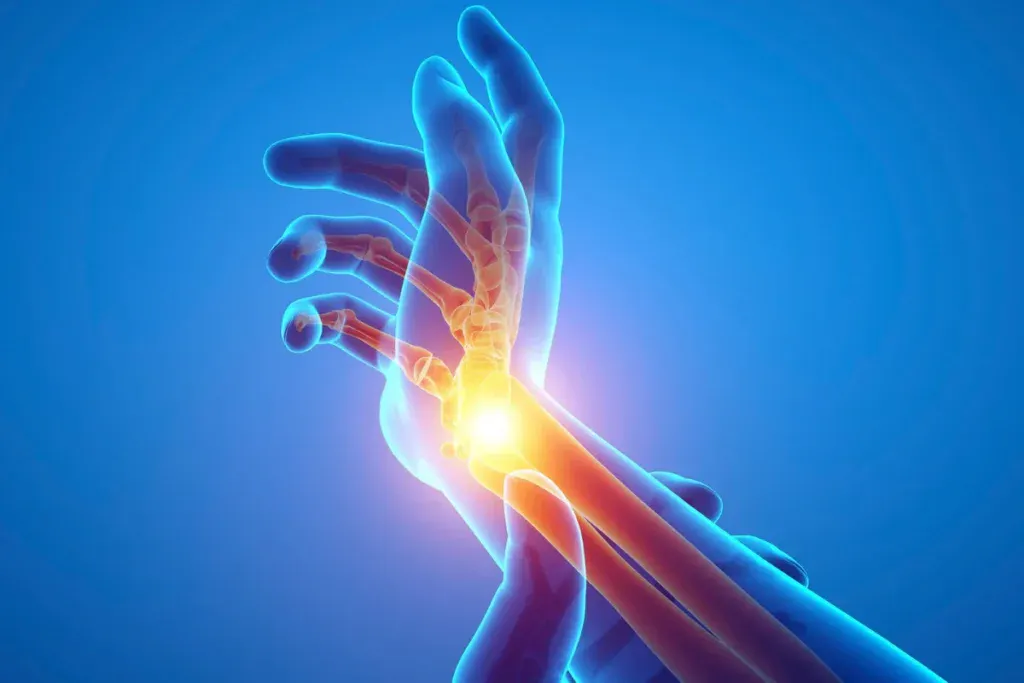
Hand pain is rarely a single condition. It tends to fall into a few recognizable categories, each with a different underlying mechanism.
Thumb base (CMC) osteoarthritis. Osteoarthritis at the base of the thumb – the trapeziometacarpal or carpometacarpal (CMC) joint – is one of the most common sources of hand pain, especially in women over 50. A large Swedish health care analysis found that thumb CMC osteoarthritis affects an estimated 1.4% of the adult population overall, rising to more than 5% in women aged 70-74 (Wolf et al., Arthritis Care & Research, 2014). It typically presents as an aching or sharp pain at the base of the thumb that worsens with pinching or gripping motions.
Tendinopathy. Repetitive use or age-related degeneration can affect the tendons of the hand and wrist, leading to conditions such as de Quervain’s tenosynovitis (involving the thumb-side tendons at the wrist) or general flexor/extensor tendinopathy. These conditions involve microscopic tendon changes rather than classic inflammation, which is part of why they can be slow to resolve.
Trigger finger (stenosing tenosynovitis). This condition occurs when a flexor tendon in the finger becomes irritated and thickened relative to its surrounding sheath, causing catching, locking, or a painful “click” as the finger bends or straightens. It is associated with repetitive gripping and is more common among people with diabetes.
Carpal tunnel syndrome. Compression of the median nerve as it passes through the carpal tunnel in the wrist can cause numbness, tingling, and pain that radiates into the hand and fingers. It is one of the most frequently diagnosed nerve-related hand conditions and, interestingly, appears to occur more often in people who also have thumb CMC osteoarthritis, suggesting these conditions may share contributing biomechanical factors.
Conventional Treatment Approaches
Standard care for chronic hand pain usually follows a stepwise approach, starting with the least invasive options.
- Activity modification and splinting to offload the affected joint or tendon and allow irritated tissue to settle.
- Hand therapy or occupational therapy, which may include targeted exercises, joint protection strategies, and adaptive techniques for daily tasks.
- Oral or topical anti-inflammatory medication to help manage pain and discomfort during flare-ups.
- Corticosteroid injections, which remain a common first-line injectable option for thumb arthritis, trigger finger, and tendon sheath inflammation, and are generally effective for short-term symptom relief.
- Surgical intervention, reserved for cases that do not respond to conservative measures – including trapeziectomy for advanced thumb arthritis, trigger finger release, or carpal tunnel release.
Conventional care remains the foundation of hand pain management. Regenerative approaches are increasingly being studied as an additional option for people looking for alternatives to repeated steroid injections or those hoping to delay surgical intervention, rather than as a replacement for established care.
How Regenerative Medicine (PRP and Stem Cell Therapy) Works for Hand Conditions
Regenerative medicine approaches for musculoskeletal conditions generally aim to support the body’s own tissue repair processes rather than simply masking pain.
PRP therapy for hand pain involves drawing a small sample of a patient’s own blood, processing it to concentrate the platelets, and injecting this platelet-rich fraction into or around the affected joint or tendon. Platelets contain growth factors and signaling proteins that are thought to help modulate local inflammation and support the tissue’s natural healing response. In hand applications, PRP has been studied for thumb base osteoarthritis, trigger finger, de Quervain’s tenosynovitis, and carpal tunnel syndrome.
Stem cell therapy for hand pain typically involves the use of mesenchymal stem cells (MSCs), which are of interest because of their ability to differentiate into multiple tissue types and their immunomodulatory properties – meaning they may help regulate the local inflammatory environment within a joint or tendon. In broader osteoarthritis research, MSC-based approaches have been evaluated for their potential to support cartilage-related outcomes and reduce joint pain, though hand-specific stem cell research remains more limited than research on larger joints like the knee. For pain concentrated at the wrist specifically, our article on stem cell therapy for wrist pain covers that joint in more depth.
Both approaches are generally performed as outpatient, minimally invasive procedures, often guided by ultrasound imaging to help ensure accurate placement within the joint, tendon sheath, or perineural space.
What the Evidence Shows
Research on regenerative medicine for hand pain is still developing, and results vary meaningfully depending on the specific condition and study design.
For thumb base osteoarthritis, a rigorous double-blind, randomized, placebo-controlled trial found that a single PRP injection did not produce a statistically significant reduction in pain compared to a saline placebo at six months, and there were no clinically meaningful differences in grip strength or thumb mobility between groups (Evans et al., JBJS Open Access, 2025). The authors noted that earlier, more favorable studies may have been limited by a lack of blinding or proper control groups – a useful reminder that not all positive early findings hold up under stricter research conditions.
For carpal tunnel syndrome, evidence has been somewhat more encouraging. A prospective, randomized, double-blind, controlled trial found that a single ultrasound-guided PRP injection was associated with significant improvements in symptom severity scores at multiple time points, with some benefits reported up to one year after treatment (Chen et al., Archives of Physical Medicine and Rehabilitation, 2021). Our broader guide to regenerative medicine for wrists walks through this and related wrist conditions in more detail.
For trigger finger, a randomized comparison of PRP, hyaluronic acid, and corticosteroid injections in 197 patients found that corticosteroids were most effective for more severe cases, while PRP and hyaluronic acid did not show a clear short-term advantage and were also more costly (Abotaleb, Egyptian Orthopaedic Journal, 2025).
A broader narrative review of PRP for hand tendon injuries concluded that while PRP appears generally safe and may support tendon healing in some contexts, clinical results across studies remain inconsistent, and the authors called for larger, more standardized trials before firm conclusions can be drawn (Saad et al., Orthopedic Reviews, 2025).
In the broader osteoarthritis literature, a systematic review and meta-analysis of 18 randomized controlled trials found that mesenchymal stem cell injections were associated with greater pain relief and functional improvement compared to placebo at 6 and 12 months, with no increased risk of adverse events such as swelling or joint pain (Tian et al., Frontiers in Endocrinology, 2024). These findings are not hand-specific, but they help illustrate why stem cell approaches continue to draw research interest for joint conditions more generally.
Taken together, the evidence suggests that regenerative medicine may hold promise for certain hand conditions, particularly carpal tunnel syndrome, while results for thumb arthritis and trigger finger remain mixed. This is an active and evolving area of research rather than a settled one.
What Patients Should Know: Safety Considerations
Anyone considering these regenerative options for their hand should keep a few points in mind.
- These are not FDA-approved treatments for hand osteoarthritis or tendinopathy, and regenerative approaches should be viewed as an adjunct being explored alongside – not a replacement for – evidence-based conventional care.
- Individual response varies. Because study results are mixed, especially for thumb arthritis and trigger finger, outcomes are not guaranteed and may depend on condition severity, chronicity, and preparation method.
- PRP using a patient’s own blood carries a low risk profile, but temporary soreness, swelling, or bruising at the injection site is possible.
- A qualified evaluation matters. A hand surgeon or musculoskeletal specialist can help determine whether a person’s specific condition and severity make them a reasonable candidate for a regenerative approach, or whether conventional treatment should remain the priority.
- Comprehensive diagnostics help guide the conversation. Imaging, grip strength testing, and a full musculoskeletal and metabolic health picture can help clarify what may be driving hand symptoms before any injectable therapy is considered.
Frequently Asked Questions
Is PRP therapy for hand pain painful?
Most patients describe the injection as similar to a corticosteroid injection – a brief pinch or pressure sensation. Some soreness at the injection site for a day or two afterward is common.
How is regenerative medicine for hand pain different from a corticosteroid injection?
Corticosteroids work primarily by reducing inflammation, while PRP and stem cell approaches are thought to work by supporting the body’s own tissue repair signaling. Research comparing the two shows mixed results depending on the specific hand condition.
Can stem cell therapy help thumb arthritis?
Hand-specific stem cell research is still limited. Most available evidence on this approach comes from broader osteoarthritis studies, and dedicated thumb-joint research is an emerging area rather than an established treatment pathway.
How many PRP sessions are typically needed for hand conditions?
This varies by condition and protocol. Some studies evaluated a single injection, while others explored multiple sessions; there is no universal standard, which is one reason individualized evaluation matters.
Does insurance cover PRP or stem cell therapy for hand pain?
These treatments are generally considered elective or investigational for musculoskeletal hand conditions, so coverage is often limited. It is worth confirming costs and coverage directly with a provider beforehand.
Who is not a good candidate for regenerative hand injections?
People with active infections, certain blood disorders, or very advanced joint damage may not be suitable candidates. A qualified clinician can assess individual eligibility.
Can regenerative medicine replace hand surgery?
No. Current evidence positions PRP and stem cell therapy as a potential complement to conventional care, not a substitute for surgery when surgery is clinically indicated.
Is trigger finger a good candidate for PRP treatment?
Evidence so far suggests corticosteroids may work better for more severe trigger finger cases in the short term, with PRP showing no clear advantage in at least one sizable randomized comparison.
Key Takeaways
- Chronic hand pain commonly stems from thumb base osteoarthritis, tendinopathy, trigger finger, or carpal tunnel syndrome, each with distinct causes and treatment considerations.
- Conventional care – splinting, hand therapy, medication, corticosteroid injections, and surgery when needed – remains the foundation of hand pain management.
- Regenerative medicine for hand pain, including PRP and stem cell therapy, is being explored as a complementary option, with the strongest current evidence found for carpal tunnel syndrome.
- Evidence for PRP in thumb arthritis and trigger finger is currently mixed, underscoring the importance of individualized evaluation.
- These therapies are not FDA-approved for hand conditions and should be discussed with a qualified healthcare professional as part of a broader care plan.
Anyone exploring regenerative options for chronic hand pain can start by learning more about stem cell therapy and what a personalized evaluation involves, or schedule a consultation with the Ways2Well team to discuss whether a regenerative approach may fit into a broader, science-backed care plan.
References
- Wolf JM, Turkiewicz A, Atroshi I, Englund M. “Prevalence of doctor-diagnosed thumb carpometacarpal joint osteoarthritis: an analysis of Swedish health care.” Arthritis Care & Research, 2014;66(6):961-965. DOI: https://doi.org/10.1002/acr.22250
- Evans K, von Kieseritzky J, Stenseth J, Wilcke M. “Platelet-Rich Plasma Injection for Painful Trapeziometacarpal Osteoarthritis: A Double-Blind, Randomized, Placebo-Controlled Trial.” JBJS Open Access, 2025;10(2):e25.00027. DOI: https://doi.org/10.2106/JBJS.OA.25.00027
- Chen SR, Shen YP, Ho TY, et al. “One-Year Efficacy of Platelet-Rich Plasma for Moderate-to-Severe Carpal Tunnel Syndrome: A Prospective, Randomized, Double-Blind, Controlled Trial.” Archives of Physical Medicine and Rehabilitation, 2021;102(5):951-958. DOI: https://doi.org/10.1016/j.apmr.2020.12.025
- Abotaleb AF. “Is platelet-rich plasma or hyaluronic acid better than corticosteroids in treating flexor stenosing tenosynovitis?” Egyptian Orthopaedic Journal, 2025;59(4):548-558. DOI: https://doi.org/10.4103/eoj.eoj_107_24
- Saad R, Ghanem W, Ezzeddine H, Assaf F, Kiwan E, Al Fakih O, Badra M, Moucharafieh R. “Platelet-Rich Plasma Therapy in Treating Tendon Injuries of the Hand: A Narrative Review.” Orthopedic Reviews, 2025;17:147173. DOI: https://doi.org/10.52965/001c.147173
- Tian X, Qu Z, Cao Y, Zhang B. “Relative efficacy and safety of mesenchymal stem cells for osteoarthritis: a systematic review and meta-analysis of randomized controlled trials.” Frontiers in Endocrinology, 2024;15:1366297. DOI: https://doi.org/10.3389/fendo.2024.1366297
Author: Ways2Well Editorial Team
Reviewed by: Scientific Advisory Board member